
Scrolling Late at Night
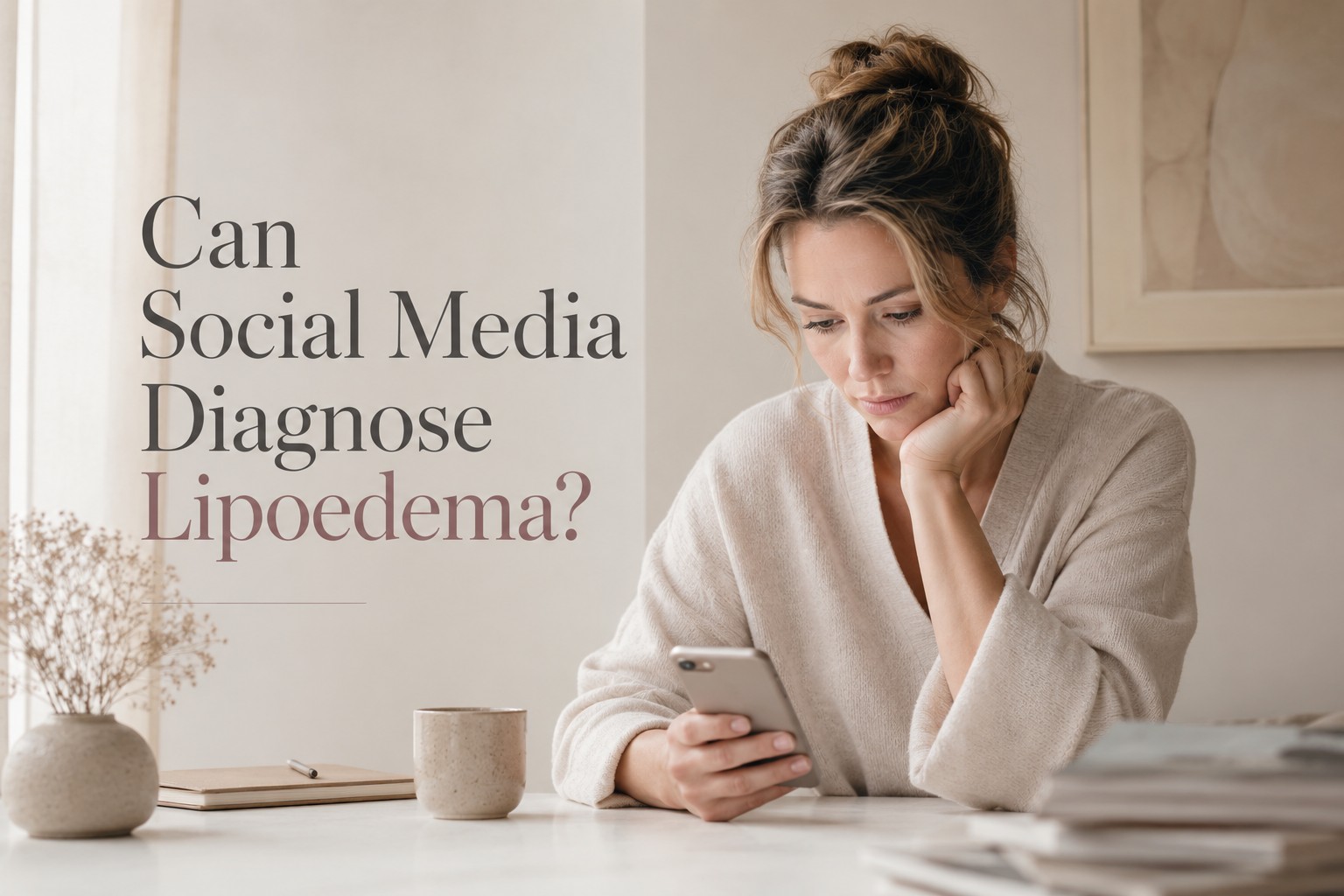
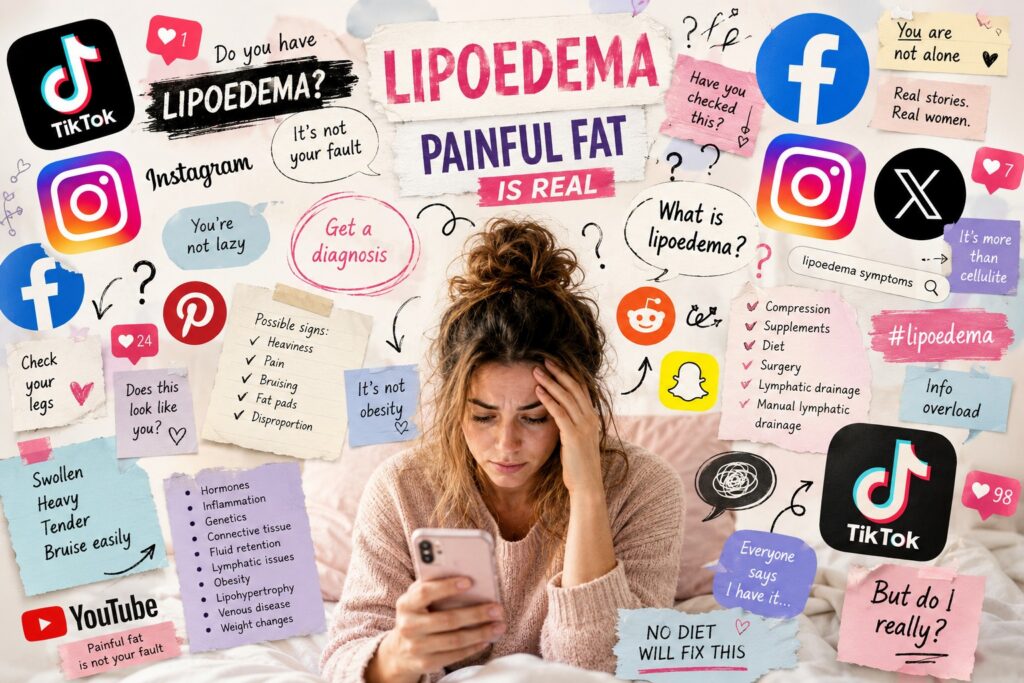
A woman lies in bed late at night scrolling through TikTok.
A video appears.
“Do your legs feel heavy?”
“Do you bruise easily?”
“Do your calves stay large even when you lose weight?”
“You might have lipoedema.”
She pauses.
Another video follows.
Then another.
Then dozens more.
Within an hour, she feels as though somebody may finally have explained her body to her.
This is increasingly how many women first encounter lipoedema today. Not in a clinic. Not through a medical consultation. Through social media.
Over the last few years, platforms such as TikTok, Instagram and Facebook have transformed awareness of lipoedema. Millions of women are now exposed to videos discussing painful fat, disproportionate body shape, swelling, bruising, inflammation and hormonal change.
For many women, these videos feel deeply relatable. That emotional recognition matters.
Many women have spent years feeling confused, ashamed or blamed for their bodies. Most have repeatedly dieted without achieving the changes they expected. Many have felt dismissed by healthcare professionals or misunderstood by those around them.
So when somebody online suddenly appears to describe experiences that feel intensely familiar, the response can be powerful.
“I thought they were talking about me.”
But increasingly, what happens next is what concerns me.
The woman continues scrolling. More videos appear. Certainty grows. Many comments from strangers confidently telling other women that they definitely have lipoedema. Gradually, she starts looking back over her entire life through this single lens.
Puberty.
Pregnancy.
Menopause.
Weight gain.
Cellulite.
Pain.
Heaviness.
Years of failed dieting.
The shape of her mother’s legs.
The way clothes never fitted properly.
Everything begins attaching itself to the possibility of lipoedema.
Why Social Media Feels So Convincing
Social media is extremely effective at creating emotional recognition. Short videos reward certainty. Algorithms reward engagement. Highly relatable stories spread rapidly. A creator points to her legs and says:
“If your body looks like this, you probably have lipoedema.”
The more a woman watches, the more similar content she is shown. Over time, social media can begin to feel less like casual browsing and more like confirmation.
This is particularly powerful because many women searching for answers already feel vulnerable, frustrated or dismissed. Some have spent years struggling with body image, dieting or symptoms they do not fully understand. Others have encountered healthcare professionals who themselves know very little about lipoedema.
Into that uncertainty steps social media, offering immediate validation, certainty and community.
The problem is that awareness and diagnosis are not the same thing.
The Complexity of Real Diagnosis
What social media rarely communicates well is the sheer complexity of female bodies and the enormous overlap that exists between lipoedema and multiple other presentations.
Obesity.
Hormonal weight redistribution.
Lipohypertrophy.
Hypermobility.
Venous disease.
Fluid retention.
Lymphatic dysfunction.
Connective tissue variation.
Normal genetic body shape.
The metabolic consequences of repeated dieting and weight cycling.
Real medicine lies within this complexity. Social media does not.
Proper diagnosis involves much more than visual pattern recognition. It requires clinical history, examination, tissue characteristics, symptom progression, hormonal influences, vascular assessment, lymphatic involvement and careful consideration of differential diagnosis.
Medicine requires nuance. Social media often strips nuance away.
When Social Media Becomes the Diagnostic Pathway
Despite these concerns, there is another uncomfortable reality underneath this discussion.
Social media is increasingly identifying possible lipoedema before medicine does.
That matters because repeated online discussion can gradually begin to acquire the appearance of medical authority. Women watching these conversations may understandably conclude that identifying lipoedema through visual resemblance, comments sections and online comparison is now a legitimate route towards diagnosis.
This trend is not confined to the UK or to problems within the NHS. The United States has an entirely different healthcare system, yet exactly the same social-media-driven diagnostic culture is emerging there as well.
Two Different Versions of the Same Wider Phenomenon
UK Television presenter, about her Instagram followers repeatedly suggesting that she may have lipoedema before she pursued assessment and treatment for herself. She eventually travelled to Germany for evaluation and recently discussed her diagnosis and surgery publicly on the ITV programme, This Morning.
Similarly, American rapper and songwriter Doja Cat later discussed in Time magazine how she had experienced what she described as a late-night “epiphany” regarding the possibility that she may have lipoedema, following widespread online discussion surrounding her body shape and appearance across TikTok, Instagram and online forums.
While the pathways differed slightly, both examples illustrate the same wider cultural shift. Increasingly, lipoedema is recognised, interpreted and diagnosed through online algorithms, comment sections and social media discussion rather than in doctor’s surgeries and clinics.
The NHS, NICE and the Gap Women Fall Into
Part of the reason this has developed is because many women feel there is nowhere else to go.
In the UK, lipoedema pathways remain inconsistent and poorly defined. Many healthcare professionals still receive very limited training in recognising or managing the condition. Access to specialist services varies significantly across the country, while clear national pathways remain lacking.
The absence of robust NICE guidance and structured NHS assessment pathways has created a vacuum.
Into that vacuum steps social media.
Women who feel unheard or unsupported naturally begin searching elsewhere for answers. Online communities can provide reassurance, validation and shared experience in ways that formal healthcare sometimes has not.
But this also creates risk.
Women should not have to rely on Instagram comments sections to navigate a complex medical diagnosis. Organisations like Lipoedema UK also play an important role in providing information, education and support for women trying to better understand the condition.
When Awareness Begins to Redefine Lipoedema
One of the growing concerns within online lipoedema discourse is the gradual expansion of the condition far beyond recognised diagnostic frameworks.
Increasingly, social media contains claims that almost any painful fat distribution, resistant weight gain, swelling or body disproportion may represent lipoedema. In some cases, the condition is being discussed in anatomical areas not traditionally recognised within established diagnostic descriptions at all, including the face and neck.
The problem is not that women are inventing symptoms or distress. Many women sharing these experiences are clearly struggling physically and emotionally.
The problem is that social media increasingly encourages interpretation before assessment. Recognition becomes mistaken for diagnosis.
Within these online communities, questioning unsubstantiated claims can quickly become difficult. Scientific discussion is sometimes interpreted as invalidation, cruelty, ignorance or “gatekeeping”. Yet medicine requires boundaries. Diagnostic criteria exist for a reason. Conditions cannot simply expand indefinitely until every presentation of adipose tissue change, swelling or body disproportion becomes absorbed into a single diagnosis.
Once the boundaries of a condition become blurred, meaningful diagnosis becomes increasingly difficult.
Other important diagnoses may then be overlooked, including obesity, lymphoedema, venous disease, endocrine conditions, medication-related weight changes or broader metabolic dysfunction.
Social Media as a Parallel Healthcare System
The influence of social media no longer stops at awareness or self-diagnosis. Increasingly, entire management pathways are developing online as well.
A woman may begin by scrolling through videos late at night and recognising herself in photographs or personal stories. From there, she joins support groups, follows influencers and starts consuming large amounts of content centred around lipoedema. Soon the discussion moves beyond symptoms and into treatment advice.
What to eat.
Which supplements to take.
What compression to buy.
Which surgeries to pursue.
What clinics to trust.
Which practitioners to follow.
Much of this information exists completely outside conventional evidence-based medical frameworks. Yet because it sits within the same online ecosystem that first made women feel recognised and understood, it can begin to feel credible through repetition and emotional reinforcement alone.
Over time, social media stops functioning simply as a source of support and begins acting as an informal parallel healthcare system, despite lacking many of the safeguards, clinical standards and evidential scrutiny expected within medicine.
Women Deserve Better Than Comment-Section Medicine
None of this means social media has no value.
For many women, social media has provided validation after years of confusion, shame or dismissal. It has increased awareness of lipoedema dramatically and helped many women realise they are not alone.
That matters.
But awareness becomes far less useful if the boundaries of the condition become so broad that the diagnosis itself begins to lose clinical meaning.
Women deserve compassionate, evidence-based assessment. They deserve clear pathways, better clinician education and properly developed healthcare services. They deserve nuance rather than simplistic certainty.
Most importantly, women deserve better than having to piece together a complex medical diagnosis alone at night through algorithms, comment sections and short-form videos.
Because while social media may increasingly be where women first encounter lipoedema, it should not be where diagnosis begins and ends.