


Introduction
Understanding how lipoedema relates to wider aspects of women’s health remains an important but developing area of clinical research.
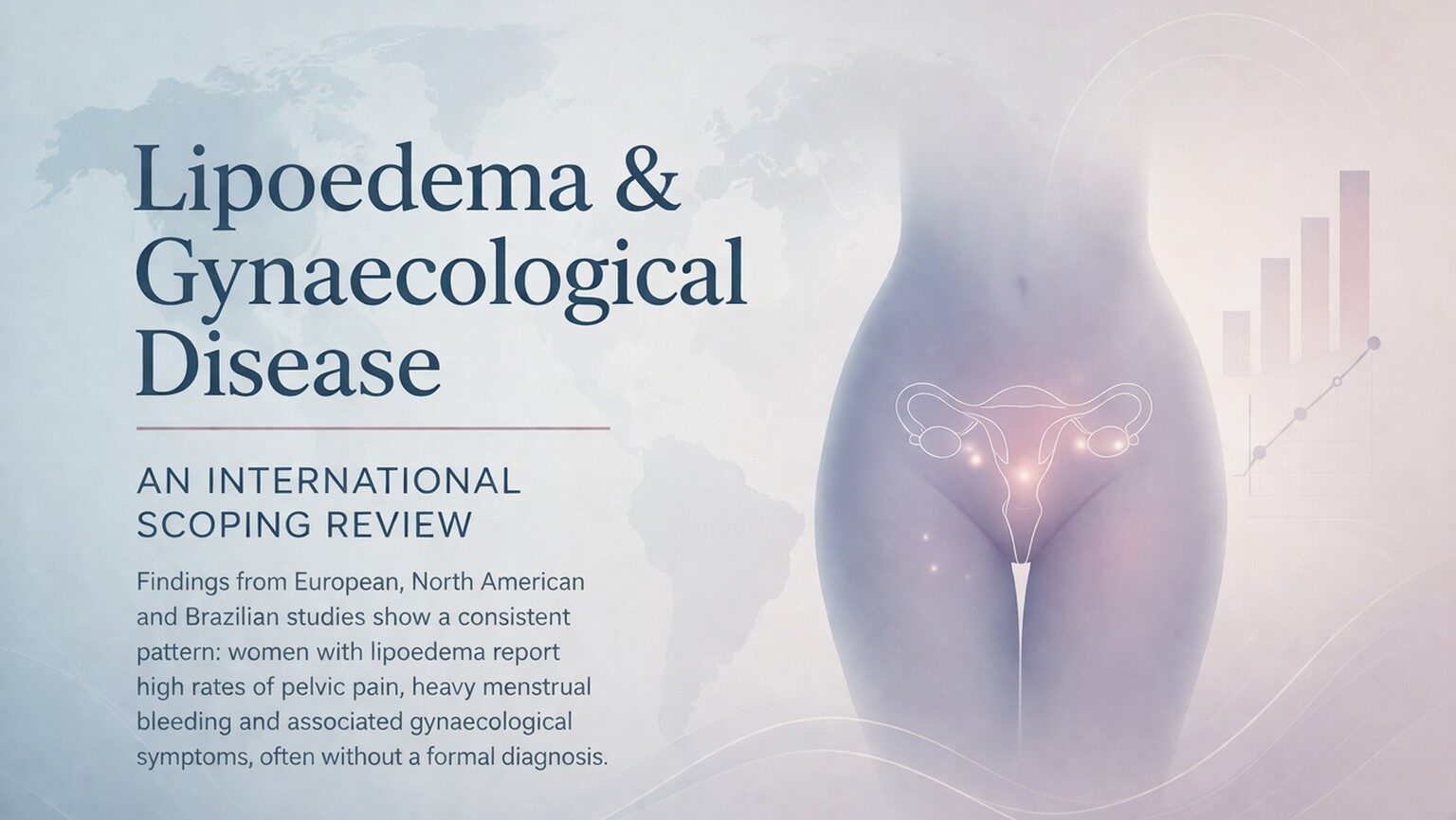
Lipedema in Women and Its Interrelationship with Endometriosis and Other Gynecologic Diseases is a 2026 scoping review by Diogo Pinto da Costa Viana, Adriana Luckow Invitti and Eduardo Schor, based at Brazilian academic institutions including the Department of Gynecology, Escola Paulista de Medicina, Federal University of São Paulo.
This paper does not introduce new patient data. Instead, it organises findings from 25 studies conducted across 10 countries in order to identify recurring clinical patterns.
International Evidence & the Spanish Cohort
This post expands on the previous article about the review of a large Spanish cohort study, whose dataset is included within this broader international review. The high prevalence of pelvic and menstrual symptoms reported in that study underpins the clinical findings identified here.
When viewed in isolation, the Spanish data can appear striking. Placed within this wider international context, it becomes clear that similar patterns are reported across European, North American and Brazilian cohorts, although described through different clinical and research frameworks.
Endometriosis is used within this review as a reference condition because of its well-established association with oestrogen-dependent inflammatory processes. The authors use it to anchor discussion of hormonal signalling, tissue inflammation and symptom patterns, rather than to suggest that lipoedema and endometriosis are equivalent conditions.
In doing so, it contributes to a growing discussion about whether lipoedema should be considered alongside hormone-sensitive and inflammatory conditions affecting women, rather than solely as a disorder of adipose distribution.
Geographic Distribution of the Evidence
The review does not directly compare populations, but it does show where the evidence is coming from:
- United States: 8 studies (32%)
- Germany: 5 studies (20%)
- Brazil: 3 studies (12%)
- United Kingdom: 2 studies
- Italy: 2 studies
- Austria: 1 study
- Poland: 1 study
- Spain: 1 study
- Switzerland: 1 study
- Germany–USA collaborative study: 1 study
European cohorts, particularly from Germany, Austria and Switzerland, have tended to describe clinical phenotype, staging and comorbidity patterns.
More recent work from the United States, Italy and Brazil has focused more heavily on endocrine signalling, intracellular hormone metabolism and genetic or molecular mechanisms.
The Spanish cohort provides large-scale observational data on symptom clustering, which is why it features prominently within the review.
Hormone-Related Timing of Onset and Progression
Across the literature reviewed, several studies reported that lipoedema frequently begins or worsens at key reproductive stages:
- Onset around puberty or adolescence: approximately 62–72% in European cohorts
- Symptom worsening during pregnancy: approximately 53%
- Progression during the menopausal transition: approximately 68%
These patterns are reported across European cohorts (Germany, Switzerland), as well as studies from the United States and Brazil, suggesting that this timing is not confined to a single population but is consistently observed across different healthcare settings.
Clinical Interpretation
These observations suggest that hormonal physiology may influence disease expression. While this does not imply that lipoedema is caused by hormonal imbalance, it supports the view that endocrine transitions may modify tissue behaviour, symptom severity and disease progression.
Practical Implication
In clinical assessment, history-taking should include detailed exploration of symptom timing in relation to reproductive life events. This may assist in recognising disease trajectories and anticipating symptom change.
Prevalence of Reproductive and Pelvic Symptoms
The review identified consistent reporting of menstrual and pelvic symptoms among women with lipoedema:
- Severe dysmenorrhoea: approximately 43%
- Menstrual irregularity: reported range 32–76%
- Chronic pelvic pain symptoms: approximately 32%
- Infertility: approximately 18%
These findings are drawn from multiple populations, including European cohorts (Spain, Germany, Italy), North American cohorts (United States), and Brazilian datasets, indicating that this pattern of symptom reporting is seen internationally rather than within a single demographic group.
Clinical Interpretation
These rates are substantially higher than general population estimates for some symptoms. Importantly, the paper distinguishes between symptom reporting and confirmed diagnosis. The data suggest that reproductive symptoms may be under-recognised or insufficiently explored in lipoedema care pathways.
Symptoms such as dysmenorrhoea and chronic pelvic pain are also core clinical features of endometriosis, making this overlap clinically significant.The review highlights that these symptoms are frequently reported in women with lipoedema, but confirmed endometriosis is reported far less often.
Practical Implication
Routine enquiry about menstrual health, pelvic pain and reproductive history should form part of standard clinical evaluation in women presenting with lipoedema.
Reported Prevalence of Gynaecological Diagnoses
Among the datasets included, reproductive symptoms were reported far more often than confirmed diagnoses showed:
- Uterine fibroids: approximately 15%
- Ovarian cysts: approximately 23%
- Polycystic ovary syndrome (PCOS): approximately 12–17%
- Surgically confirmed endometriosis: approximately 4.2%
These diagnostic rates are reported across mixed international cohorts, including European and North American populations, and contrast with the much higher prevalence of symptom reporting.
Clinical interpretation
The discrepancy between symptom reporting and confirmed diagnoses highlights the complexity of diagnostic pathways in women’s health. It suggests that reproductive symptoms may not consistently lead to specialist evaluation or formal diagnosis.
The reported prevalence of endometriosis (approximately 4.2%) is notably low in comparison to the much higher rates of pelvic pain and dysmenorrhoea. The review interprets this gap as possible under-recognition, or as a reflection of the fact that diagnostic pathways for endometriosis rely on surgical confirmation, which is not routinely undertaken.
Practical Implication
Clinicians should avoid assuming diagnostic equivalence between symptom clusters and specific gynaecological disease, while recognising the need for appropriate referral when symptoms are significant.
Findings from the Largest Cohort
The review draws particular attention to a Spanish specialist cohort (Simarro et al., 2025) of approximately 1,803 women with lipoedema. Within this dataset, a composite clinical category described as “inflammatory ovarian dysfunction” was reported in approximately 76%. This category included:
- Irregular menstrual cycles
- Heavy menstrual bleeding
- Dysmenorrhoea
- Pelvic pain
This cohort represents a European specialist population, and its findings contribute significantly to the overall symptom prevalence described in the review. This reinforces that the Spanish findings are not isolated, but form part of a wider pattern seen across the literature.
Clinical Interpretation
The authors note that this is not a standard diagnostic entity. Rather, it reflects a grouping of symptoms documented in clinical records. The high prevalence reported should therefore be interpreted as an indicator of symptom clustering rather than a defined disease.
Within this cluster, several features overlap with those typically associated with endometriosis, although no direct diagnostic equivalence is made.
Practical Implication
The findings reinforce the importance of careful clinical differentiation between symptom description and formal diagnosis.
Biological Processes
The review summarises several mechanisms proposed in previous research that may be relevant to both lipoedema and gynaecological conditions:
- Local oestrogen metabolism and aromatase activity
- Altered oestrogen receptor signalling
- Chronic inflammatory cytokine activity
- Extracellular matrix and connective tissue change
- Microvascular permeability and tissue fluid dynamics
These mechanistic discussions are drawn particularly from United States, Italian and Brazilian research, where there has been greater focus on endocrine and molecular aspects of lipoedema.
Clinical Interpretation
These mechanisms are not presented as confirmed causal pathways. Instead, they represent areas of scientific investigation that may help explain overlapping symptom patterns across different organ systems.
Where This Fits within Current Lipoedema Hypotheses
This publication sits within a growing international movement towards systemic models of lipoedema. It aligns with emerging frameworks that emphasise:
- Neuroendocrine regulation
- Connective-tissue biology
- Immune-inflammatory signalling
- Female-specific disease expression
It reflects a shift seen particularly in recent American, Italian and Brazilian literature, moving beyond earlier European lymphological models towards a more integrated understanding of tissue behaviour.
Clinical Implications
Overall, the review emphasises the importance of integrated assessment. Women presenting with lipoedema may experience symptoms affecting multiple systems, including reproductive health.
Clinicians should routinely ask about:
- Menstrual history
- Pelvic pain
- Dysmenorrhoea
- Cycle irregularity
- Heavy bleeding
- Fertility concerns
- Symptom changes at puberty, pregnancy and menopause
These patterns are reported across European, North American and Brazilian populations, suggesting they are not confined to a single demographic group. Symptoms commonly associated with endometriosis, including severe menstrual pain and chronic pelvic pain, should be actively explored in women presenting with lipoedema.
Relevance for Women in the United Kingdom
Both lipoedema and endometriosis are recognised as conditions associated with delayed diagnosis and fragmented care in the UK.
While international prevalence data cannot be directly applied to UK populations, the consistency of symptom patterns across European, American and Brazilian studies suggests that similar presentations are likely to be encountered in UK clinical practice.
Conclusion
The 2026 scoping review contributes to an evolving understanding of lipoedema within the broader context of women’s health.
By consolidating international evidence from European, North American and Brazilian populations, it draws attention to the need for comprehensive clinical assessment and further research into potential shared biological mechanisms.
Although definitive causal relationships remain unproven, this review supports a more integrated approach to understanding complex symptom patterns in women with lipoedema.