
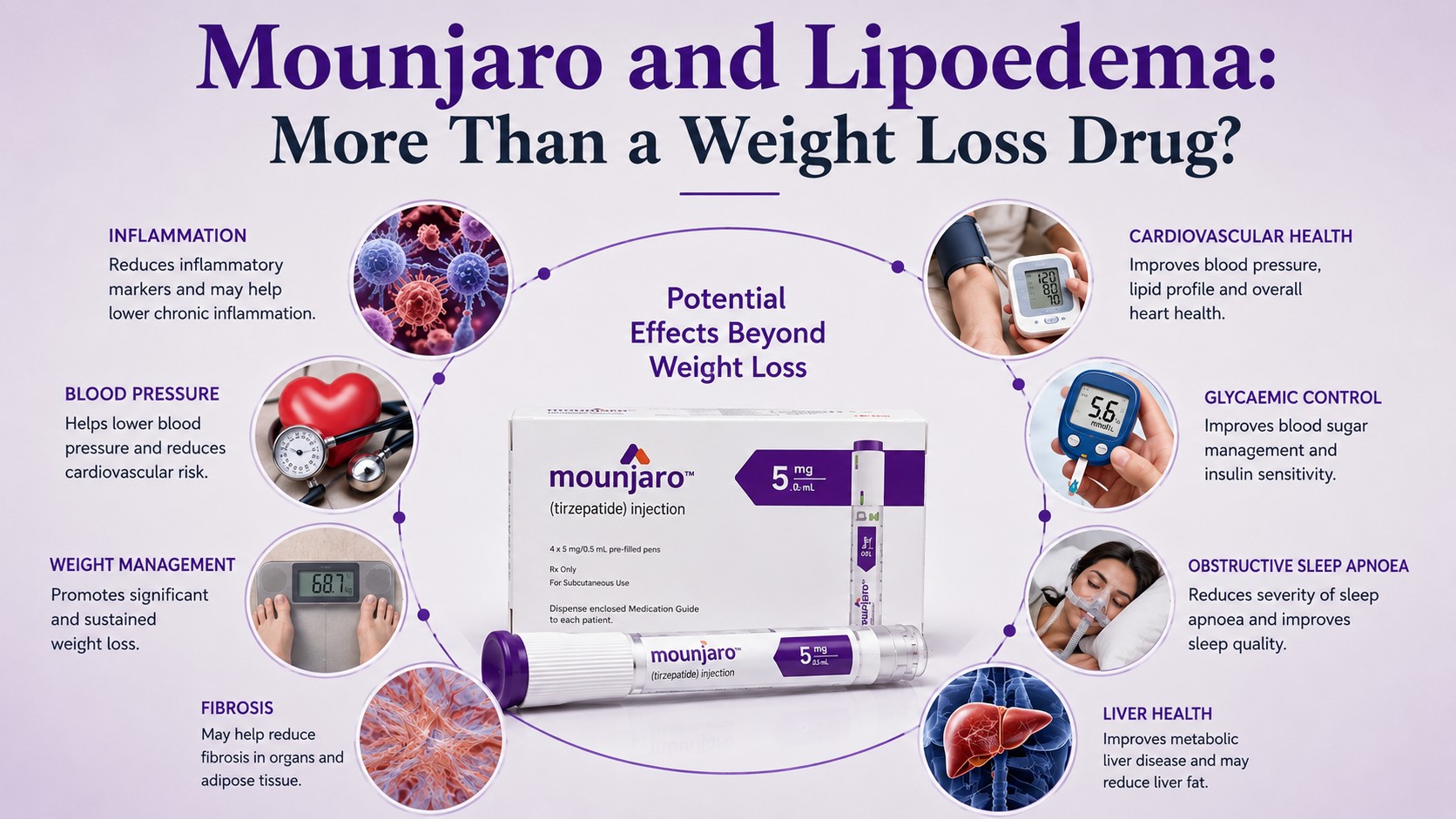



Mounjaro has become widely known as a weight-loss drug but research into tirzepatide, its active ingredient, now extends well beyond its use in weight reduction.
Lipoedema is also more complex than excess fat deposition. Current research describes changes involving adipose tissue function, inflammation, fibrosis and the extracellular matrix, alongside vascular, hormonal and metabolic changes. Mitochondrial dysfunction and oxidative stress are also being investigated.
In 2025, Viana, Invitti and Schor published a review specifically examining tirzepatide as a potential disease-modifying therapy for lipoedema. They considered its effects on metabolism, inflammation, fibrosis, mitochondrial function and adipose-tissue remodelling.
Research specifically involving Mounjaro and lipoedema remains limited, but there is now enough evidence to look beyond weight loss alone.
What is Mounjaro?
Mounjaro is the brand name for tirzepatide, a medication that acts on two hormone receptors: GIP (glucose-dependent insulinotropic polypeptide) and GLP-1 (glucagon-like peptide-1).
These hormones are involved in appetite, insulin secretion, glucose regulation and energy metabolism. Tirzepatide was initially developed for type 2 diabetes and is now also licensed in the UK for weight management.
For someone living with both obesity and lipoedema, substantial weight reduction can improve mobility and general metabolic health. The effects of tirzepatide on inflammation, insulin resistance, cardiovascular health and other metabolic pathways have widened the discussion.
Mounjaro, Inflammation and Lipoedema
Adipose tissue is metabolically active. It contains adipocytes, blood vessels, connective tissue and immune cells and produces signalling molecules involved in inflammation.
Research into lipoedema has identified inflammatory signalling, immune-cell activity, vascular changes and extracellular matrix abnormalities within affected tissue.
The evidence that tirzepatide affects systemic inflammatory markers has also become stronger.
In 2026, Sattar and colleagues published a post-hoc analysis of the SURMOUNT-1 trial examining cardiovascular-risk biomarkers after 72 weeks of tirzepatide treatment. Compared with placebo, high-sensitivity C-reactive protein (hsCRP) fell by approximately 37–55%, depending on dose, and interleukin-6 (IL-6) by approximately 25–30%. Improvements were also found in markers associated with insulin resistance, adiposity, hepatic stress and endothelial dysfunction.
Many of these changes correlated with weight loss, so we cannot simply separate the metabolic and anti-inflammatory effects from the reduction in body fat. They do show that the physiological effects of tirzepatide extend considerably beyond appetite suppression.
Tirzepatide and Lipoedema Pain
In 2025, Bicca and Murta reported a case involving a 34-year-old woman with type 2, stage III lipoedema and a BMI of 30.
She was treated with tirzepatide after previously using semaglutide without clinical success and lost 17 kg over seven months.
Tirzepatide was gradually withdrawn. She maintained her diet and exercise programme and continued to lose weight, but five months later her lipoedema pain returned and the appearance of her skin deteriorated.
By this stage she had reached a normal BMI and her weight was stable. Tirzepatide was restarted at a low dose of 1.5 mg weekly, with the stated aim of addressing inflammation and pain rather than producing further weight loss.
After 30 days, she reported complete remission of pain and improvement in skin texture.
This is a single case report, not a clinical trial. The sequence is nevertheless relevant to the question of whether tirzepatide may have effects beyond weight reduction: her symptoms returned despite continued weight loss and improved after tirzepatide was reintroduced.
Fibrosis and Adipose Tissue
Fibrosis and changes within the extracellular matrix are increasingly recognised in lipoedema tissue.
The extracellular matrix provides the structural framework surrounding cells. Changes in collagen deposition and extracellular matrix remodelling may contribute to the firmness, nodularity and altered tissue texture seen as lipoedema progresses.
Tirzepatide has also been studied in another condition involving metabolic dysfunction, inflammation and fibrosis.
In 2024, Loomba and colleagues published the SYNERGY-NASH trial in the New England Journal of Medicine. Participants with metabolic dysfunction-associated steatohepatitis (MASH) and moderate or severe fibrosis received tirzepatide or placebo for 52 weeks.
Resolution of MASH without worsening of fibrosis occurred considerably more frequently with tirzepatide than placebo. Improvement of at least one fibrosis stage without worsening of MASH was also more frequent in the tirzepatide groups.
Liver fibrosis and fibrosis within lipoedema tissue are not the same disease process. The findings do, however, add to the research examining how tirzepatide may affect inflammatory and fibrotic pathways.
Viana and colleagues also discussed macrophage activity, cytokine signalling, extracellular matrix turnover, mitochondrial function, thermogenesis and adipose-tissue remodelling in their 2025 review of tirzepatide and lipoedema.
Lipoedema and Associated Conditions
Many women with lipoedema also present with other health conditions and symptoms.
Research has reported associations with endocrine and gynaecological conditions, metabolic dysfunction, hypermobility and connective-tissue disorders. Conditions including PCOS, endometriosis, adenomyosis and fibroids have also been reported within the wider clinical picture. Some women report mast-cell-related symptoms.
I have written separately in the Lipoedema Lounge about the large Spanish study examining lipoedema and associated conditions, gynaecological conditions and lipoedema, mast cell activation syndrome, and the overlap between lipoedema and other multi-system conditions. I will also be looking separately at hypermobility and Ehlers-Danlos syndrome.
These associations do not necessarily share a single cause. They do show why lipoedema cannot be understood simply by looking at the amount of fat on someone’s legs.
Mounjaro is not a treatment for all of these conditions. Its effects on glucose regulation, insulin resistance, metabolism and inflammatory pathways may nevertheless be relevant when someone with lipoedema also has metabolic or other associated health problems.
Beyond Weight Loss
The wider evidence for tirzepatide has developed rapidly.
Research now extends into cardiovascular health, obesity-related heart failure, obstructive sleep apnoea, metabolic liver disease, inflammation and the prevention of type 2 diabetes.
Cardiovascular Health and Heart Failure
In 2025, Packer and colleagues published the SUMMIT trial in the New England Journal of Medicine, examining tirzepatide in people with obesity and heart failure with preserved ejection fraction (HFpEF).
Tirzepatide reduced the combined risk of cardiovascular death or worsening heart failure and improved health status and exercise tolerance.
The 2026 analysis by Sattar and colleagues also found improvements across several cardiovascular-risk pathways, including inflammatory markers, insulin resistance, endothelial dysfunction and metabolic and hepatic stress.
Obstructive Sleep Apnoea
In 2024, Malhotra and colleagues published the SURMOUNT-OSA trials in the New England Journal of Medicine.
These two phase 3 trials studied adults with obesity and moderate-to-severe obstructive sleep apnoea. Tirzepatide produced substantial reductions in the apnoea-hypopnoea index, alongside weight reduction and improvements in other cardiovascular-risk measures.
Metabolic Liver Disease
The 2024 SYNERGY-NASH trial by Loomba and colleagues demonstrated substantial effects in MASH, including resolution of the disease without worsening fibrosis in a significant proportion of participants and improvement in fibrosis in some patients.
Prevention of Type 2 Diabetes
In 2025, Jastreboff and colleagues published the three-year SURMOUNT-1 results in the New England Journal of Medicine.
People with obesity and prediabetes treated with tirzepatide had sustained weight reduction and a markedly lower risk of progressing to type 2 diabetes during 176 weeks of treatment.
Across the tirzepatide research programme, improvements have also been demonstrated in blood pressure, lipid profiles, glucose regulation, insulin sensitivity and inflammatory markers.
Some of these benefits will result from substantial weight loss. Others may reflect additional metabolic and cellular effects of GIP and GLP-1 receptor activation. Research is continuing to establish how much each contributes.
For someone living with lipoedema alongside obesity, insulin resistance, prediabetes, type 2 diabetes, sleep apnoea or cardiovascular risk factors, the effects of treatment may therefore extend considerably beyond the number on the scales.
Does Mounjaro Reduce Lipoedema Fat?
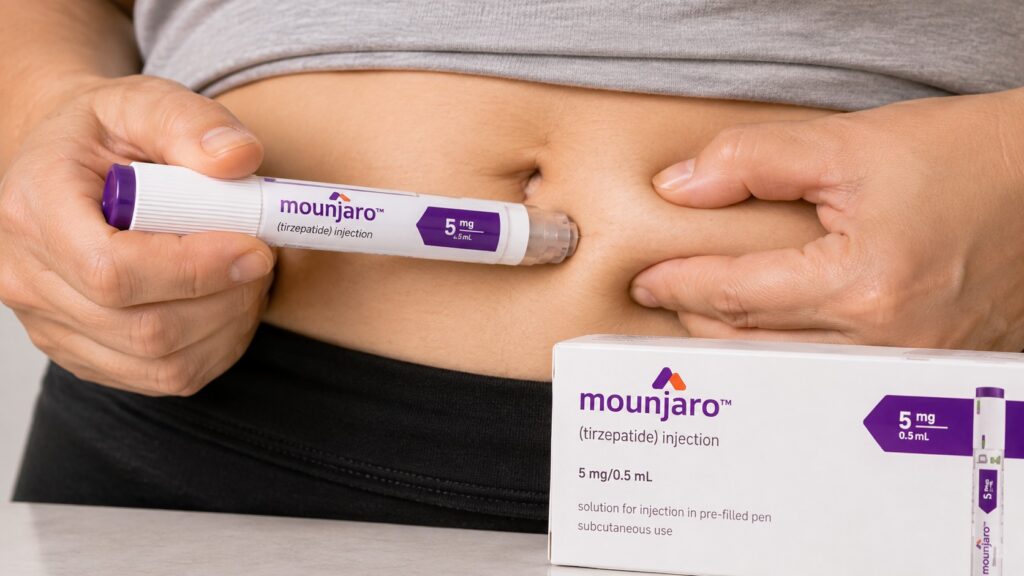
We do not yet know whether tirzepatide specifically reduces pathological lipoedema adipose tissue.
A woman with lipoedema and obesity may lose substantial amounts of non-lipoedema fat while taking Mounjaro. Changes may also occur within affected limbs, but weight and circumference measurements alone cannot establish whether this represents loss of ordinary adipose tissue, changes within lipoedema tissue, changes in extracellular fluid or a combination of these.
Lipoedema also occurs across a wide range of body weights. A woman can have significant and painful lipoedema without obesity.
If future trials demonstrate improvements in pain, inflammation, tissue structure or fibrosis that are partly independent of weight reduction, the clinical implications would be different from using Mounjaro solely for obesity.
The Bicca and Murta case report provides an early observation of this possibility. It now needs to be investigated in properly designed clinical trials.
Is Mounjaro Available for Lipoedema on the NHS?
Mounjaro is not currently licensed specifically as a treatment for lipoedema, and lipoedema alone does not make someone eligible for tirzepatide on the NHS.
In England, NICE recommends tirzepatide for weight management within defined BMI and weight-related comorbidity criteria. NHS England is introducing access through a phased rollout, so NHS eligibility is currently narrower than the overall UK marketing authorisation.
Someone with lipoedema may therefore receive Mounjaro because they independently meet the criteria for type 2 diabetes or weight management, rather than because Mounjaro is being prescribed to treat lipoedema itself.
More than a Weight-Loss Drug?
Mounjaro produces substantial weight loss, but the evidence surrounding tirzepatide now extends much further.
Clinical research has demonstrated effects across glucose metabolism, cardiovascular-risk markers, systemic inflammation, heart failure, obstructive sleep apnoea and metabolic liver disease.
At the same time, research into lipoedema is identifying changes involving adipose-tissue function, inflammation, fibrosis, extracellular matrix remodelling, vascular function and metabolism.
Viana, Invitti and Schor proposed tirzepatide as a potential disease-modifying therapy for lipoedema in 2025. Bicca and Murta subsequently reported improvement in pain and skin symptoms after low-dose tirzepatide was restarted in a woman who had already reached a normal BMI.
Neither provides proof that Mounjaro treats lipoedema. They provide a basis for clinical trials designed specifically for women with lipoedema.
Those trials need to measure more than weight. Pain, tissue composition, limb volume, inflammatory markers, fibrosis, metabolic changes and quality of life all need to be assessed.
Mounjaro remains a treatment for its licensed indications rather than an established treatment for lipoedema.
Future clinical trials will need to establish whether tirzepatide can also change the symptoms or underlying tissue changes associated with lipoedema.
Bibliography
- Viana DPC, Invitti AL, Schor E. Tirzepatide as a Potential Disease-Modifying Therapy in Lipedema: A Narrative Review on Bridging Metabolism, Inflammation, and Fibrosis. International Journal of Molecular Sciences. 2025;26(21):10741. doi:10.3390/ijms262110741.
- Bicca J, Murta I. SAT-685 Low-dose Tirzepatide For The Treatment Of Patient With Lipedema: A Case Report. Journal of the Endocrine Society. 2025;9(Suppl 1):bvaf149.119. doi:10.1210/jendso/bvaf149.119.
- Sattar N, Linetzky B, Ruotolo G, et al. Comprehensive Long-Term Changes in Cardiovascular Risk Biomarkers With Tirzepatide: A SURMOUNT-1 Post Hoc Analysis. Journal of the American College of Cardiology. 2026. Published online 3 June 2026. doi:10.1016/j.jacc.2026.04.044.
- Loomba R, Hartman ML, Lawitz EJ, et al. Tirzepatide for Metabolic Dysfunction-Associated Steatohepatitis with Liver Fibrosis. New England Journal of Medicine. 2024;391(4):299–310. doi:10.1056/NEJMoa2401943.
- Packer M, Zile MR, Kramer CM, et al. Tirzepatide for Heart Failure with Preserved Ejection Fraction and Obesity. New England Journal of Medicine. 2025;392(5):427–437. doi:10.1056/NEJMoa2410027.
- Malhotra A, Grunstein RR, Fietze I, et al. Tirzepatide for the Treatment of Obstructive Sleep Apnea and Obesity. New England Journal of Medicine. 2024;391(13):1193–1205. doi:10.1056/NEJMoa2404881.
- Jastreboff AM, le Roux CW, Stefanski A, et al. Tirzepatide for Obesity Treatment and Diabetes Prevention. New England Journal of Medicine. 2025;392(10):958–971. doi:10.1056/NEJMoa2410819.