


Hormones are one of the most frequently discussed, and frequently misunderstood, subjects in lipoedema.
Women are often told that lipoedema is “caused by oestrogen”, that the contraceptive pill will make it progress, that IVF drugs can trigger it, or that hormone replacement therapy (HRT) should be avoided after menopause. More recently, GLP-1 medicines have entered the discussion, with claims that they may have effects on lipoedema beyond weight loss.
There are understandable reasons why these ideas have developed. Lipoedema occurs overwhelmingly in women, and many women first notice symptoms, or report changes in existing symptoms, around puberty, pregnancy or menopause. Research is also beginning to identify differences in hormone signalling and oestrogen metabolism within lipoedema tissue.
None of this, however, demonstrates that taking an oestrogen-containing medication causes lipoedema or inevitably makes established lipoedema worse. Nor does an interesting biological mechanism necessarily mean that a medication treats lipoedema.
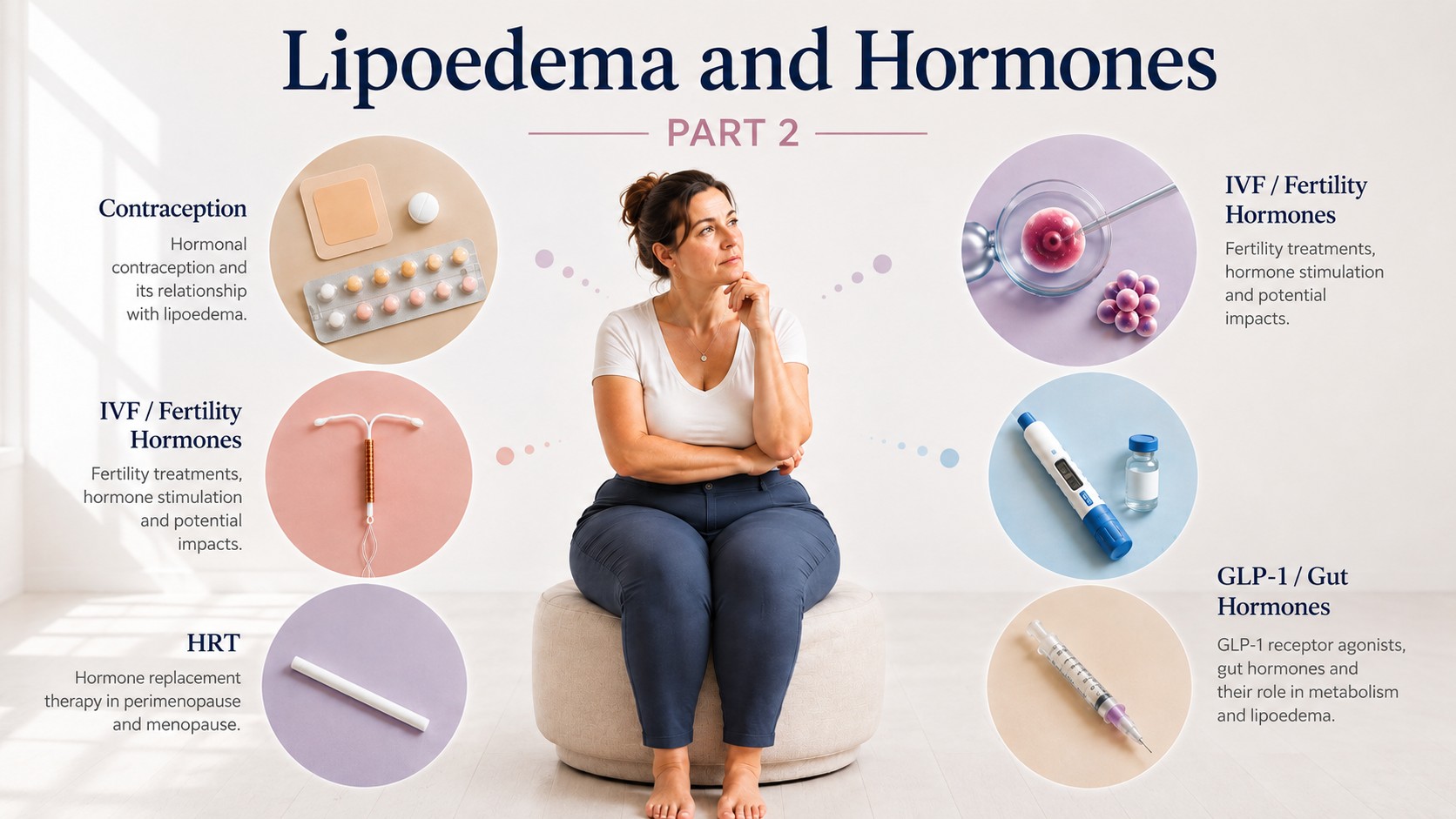
In Part 1, we looked at lipoedema across the natural hormonal transitions of a woman’s life. Part 2 looks at prescribed hormones — HRT, hormonal contraception and fertility treatment — together with GLP-1 medicines, which are increasingly being discussed in relation to lipoedema.
Is Lipoedema an Oestrogen-Driven Condition?
There are good biological reasons for investigating oestrogen in lipoedema.
Oestrogen has important effects on adipose tissue, including fat distribution, adipocyte biology, metabolism and vascular function. Adipose tissue itself can also produce and metabolise oestrogens.
Research into lipoedema tissue has identified potentially important differences in oestrogen receptors and enzymes involved in local oestrogen metabolism. Laboratory studies have also found differences in the response of lipoedema-derived adipose cells to oestrogen.
These findings may eventually help explain why lipoedema predominantly affects women and why the distribution of affected adipose tissue is so characteristic. They do not, at present, tell us what happens clinically when a woman with lipoedema takes HRT, hormonal contraception or fertility medication.
The distinction between a laboratory mechanism and a clinical effect is important. Demonstrating that oestrogen influences a lipoedema-derived adipocyte in vitro does not demonstrate that an oestrogen patch, contraceptive pill or IVF cycle causes lipoedema to progress in the female body.
The most recent systematic review of hormones and lipoedema, published in 2026, identified only 15 publications suitable for inclusion. The authors identified several possible hormonal mechanisms, including altered oestrogen metabolism and oestrogen-receptor function.
The small evidence base is itself significant. Hormonal involvement in lipoedema is a credible and important area of research, but our understanding of the effect of prescribed hormones remains limited.
HRT and Lipoedema
HRT is an area in which women with lipoedema can receive particularly conflicting advice.
A woman may reach perimenopause, develop significant menopausal symptoms and be offered HRT, only to encounter warnings that taking oestrogen could make her lipoedema progress. Understandably, this can create considerable anxiety about starting treatment.
There is currently no good clinical evidence demonstrating that appropriately prescribed HRT causes progression of lipoedema.
This does not mean that women with lipoedema cannot experience changes after starting HRT. Oestrogen and progestogens can influence fluid balance, breast tenderness, weight and other symptoms, and responses to HRT vary between women irrespective of whether they have lipoedema.
A noticeable change following the introduction of HRT deserves assessment, particularly where the timing is clear. It is nevertheless important to distinguish between an increase in fluid, a change in body weight or body composition and actual progression of lipoedema adipose tissue. They are not interchangeable.
Without objective longitudinal studies, a change occurring after HRT cannot automatically be attributed to HRT or assumed to represent an increase in lipoedema tissue.
What About Transdermal Oestrogen?
HRT encompasses several different preparations and routes of administration.
Oestrogen can be taken orally or delivered through the skin as a patch, gel or spray. In the UK, transdermal preparations commonly contain 17β-oestradiol, which is chemically identical to the principal oestrogen produced by the human ovary.
There are established medical reasons for considering the route of administration. NICE advises considering transdermal rather than oral HRT in women at increased risk of venous thromboembolism, including women with a BMI above 30. Transdermal HRT is not associated with the same increase in VTE risk seen with oral HRT.
This may be relevant to some women with lipoedema who also have obesity, reduced mobility, venous disease or other risk factors.
It does not follow that transdermal oestrogen has been shown to be safer specifically for lipoedema, or that oral oestrogen has been shown to cause lipoedema progression. Comparative studies examining these routes in women with lipoedema have not been carried out.
Bioidentical Hormones: What Does the Term Actually Mean?
The term “bioidentical HRT” is widely used in private hormone treatment and marketing, sometimes creating the impression that bioidentical hormones are a separate, more natural form of HRT.
In fact, some routinely prescribed, licensed HRT preparations are already bioidentical, or body-identical. The 17β-oestradiol used in licensed HRT patches, gels and sprays is bioidentical oestrogen, while micronised progesterone is bioidentical progesterone.
It is therefore not necessary to use individually compounded preparations in order to receive hormones that are chemically identical to those produced by the human body.
The more useful distinction is between regulated, licensed preparations and individually compounded hormone products, where dose, purity, consistency and safety have not necessarily been subjected to the same regulatory scrutiny.
The British Menopause Society states that the benefits attributed to bioidentical hormone therapy can be achieved using conventionally licensed products without resorting to unregulated compounded preparations.
This is relevant to lipoedema because uncertainty about the role of hormones has created a market for claims about “balancing hormones”, “oestrogen dominance” and treatments intended to correct an assumed hormonal cause of lipoedema.
There is currently no established treatment for lipoedema based on correcting a systemic oestrogen imbalance.
Hormonal Contraception and Lipoedema
Hormonal contraception is particularly interesting because some direct observational evidence is now available.
A 2026 Brazilian cross-sectional study included 637 women with suspected or confirmed lipoedema. Of the 588 participants who had used hormonal contraception, 58.8% reported some worsening of their lipoedema symptoms after starting contraception. Around 40% reported no change and fewer than 1% reported improvement.
In addition, 15.1% of the total study population reported that the onset of their lipoedema symptoms coincided with starting hormonal contraception.
These findings deserve attention, but the design of the study limits the conclusions that can be drawn from them.
Participants completed an online, cross-sectional questionnaire and were recruited through social media, lipoedema support groups, specialist clinics and patient organisations. Not all participants had a confirmed diagnosis of lipoedema, and women were being asked retrospectively to recall symptoms and their relationship to previous contraceptive use.
There was no untreated control group and no objective measurement of lipoedema tissue before and after contraception.
The most commonly reported contraceptive-associated changes included weight gain and swelling. Both can alter limb size, symptoms and the appearance of the legs, but neither on its own demonstrates an increase in lipoedema adipose tissue.
The authors concluded that prospective studies using objective measurements are needed to investigate causality.
The study therefore provides useful evidence of a possible association and, importantly, identifies an issue that warrants further investigation. It cannot establish that hormonal contraception causes the onset or progression of lipoedema.
Does the Type of Contraception Matter?
Hormonal contraceptives differ substantially in both their hormonal components and their routes of administration. They include:
- combined oral contraception containing oestrogen and a progestogen
- progestogen-only pills
- levonorgestrel intrauterine systems such as Mirena®
- contraceptive implants
- hormonal injections.
These methods do not produce identical hormonal exposure, so it is reasonable to ask whether they might affect lipoedema differently. At present, good prospective studies comparing them in women with confirmed lipoedema are lacking.
There is therefore insufficient evidence to recommend that every woman with lipoedema avoids combined hormonal contraception. Equally, it cannot be assumed that a progestogen-only method or hormonal intrauterine system will have no effect on an individual woman’s symptoms.
Contraceptive choice should take account of the reason contraception is required, previous experience, bleeding pattern, migraine history, cardiovascular and thrombotic risk, body weight, other medical conditions and the woman’s preferences. Lipoedema can be included in that assessment without becoming the sole determinant of contraceptive choice.
Where pain, swelling or limb size appears to change significantly after starting a contraceptive, documenting the timing and nature of the change can be useful before discussing alternative preparations with the prescribing clinician.
Stopping effective contraception solely because of claims encountered online is not supported by the current evidence.
IVF, Fertility Treatment and Lipoedema
Fertility treatment raises a slightly different question because ovarian stimulation deliberately produces substantial hormonal changes over a relatively short period.
During IVF, medication is used to stimulate the development of multiple ovarian follicles, and circulating hormone concentrations can differ considerably from those of an ordinary menstrual cycle.
An effect on lipoedema is therefore biologically plausible, but it has not been adequately investigated. There is currently no convincing clinical evidence demonstrating that IVF causes permanent progression of lipoedema.
Women may experience bloating, fluid shifts and changes in body weight during ovarian stimulation. Fertility specialists also monitor for ovarian hyperstimulation syndrome (OHSS), a recognised complication of pharmacological ovarian stimulation.
These effects should not automatically be interpreted as progression of lipoedema.
Establishing cause becomes still more difficult when fertility treatment results in pregnancy. Ovarian stimulation may then be followed by pregnancy and the postpartum period, each accompanied by substantial hormonal, circulatory, fluid and body-composition changes.
If a woman’s legs increase in size during this period, it may be impossible retrospectively to determine the respective contributions of fertility medication, pregnancy, fluid retention, weight change and lipoedema itself.
This is a significant gap in lipoedema research and one that would be better addressed through prospective studies following women before, during and after fertility treatment, with objective measurements rather than retrospective reports alone.
Until such evidence exists, women with lipoedema undergoing fertility treatment should be managed according to established fertility principles, with their full medical history considered by their fertility specialist. Lipoedema alone is not evidence that clinically indicated fertility treatment should be withheld.
GLP-1 Medications and Lipoedema
GLP-1 medicines have become increasingly prominent in discussions about lipoedema as their use in obesity and type 2 diabetes has expanded.
Semaglutide is a GLP-1 receptor agonist, while tirzepatide acts on both GIP and GLP-1 receptors. Both can produce substantial weight loss, and this inevitably raises questions about what happens when they are used by women with lipoedema.
There is an important distinction between using these medicines in a woman who has lipoedema and an established medical indication for treatment, and using them specifically to treat lipoedema.
Women with lipoedema can lose weight. The long-standing description of lipoedema fat as “diet resistant” has sometimes been interpreted too literally, creating the impression that adipose tissue within an affected limb cannot change with weight loss.
In reality, a limb affected by lipoedema does not consist solely of lipoedema adipose tissue. A woman who loses a substantial amount of weight may lose fat from her legs as well as elsewhere in her body. Reduced overall body weight may also improve mobility, mechanical loading and metabolic health, and may affect pain and physical function.
These are important clinical benefits, but they do not demonstrate that a GLP-1 medicine has specifically treated the underlying lipoedema.
GLP-1s Beyond Weight-Loss
There are nevertheless reasons why these medicines are of scientific interest beyond weight loss. GLP-1 receptor agonists have effects on glucose regulation, insulin sensitivity and adipose tissue metabolism, and wider metabolic and inflammatory effects continue to be investigated.
Some of these mechanisms could conceivably be relevant to lipoedema. At present, however, we do not have good clinical evidence showing that semaglutide, tirzepatide or other GLP-1-based medicines specifically reduce pathological lipoedema adipose tissue or alter the underlying disease process independently of their effects on weight and metabolism.
This distinction is important when dramatic changes in body shape are presented as evidence that lipoedema has been reversed. A woman with lipoedema who loses a large amount of weight may have substantially smaller limbs and feel considerably better. That is a worthwhile outcome in itself. It does not tell us which component of the reduction represents ordinary adipose tissue and whether the biology of her lipoedema has changed.
What about GLP-1 medicines in women who are not obese?
This is where claims about GLP-1 medicines as a specific lipoedema treatment require particular caution.
There is currently insufficient evidence to support prescribing GLP-1-based medicines solely for the treatment of lipoedema in women who do not otherwise have an established indication for their use.
The same applies to the growing discussion around “microdosing” GLP-1 medicines for lipoedema. There is currently no established evidence-based microdosing protocol for treating lipoedema.
Interesting mechanisms involving inflammation, metabolism or adipose tissue biology can provide a reason to undertake research. They are not, by themselves, evidence that a medicine works clinically.
For a woman with lipoedema who also meets established criteria for pharmacological weight management or has another recognised indication, GLP-1-based treatment may be entirely appropriate. Improvements in weight, metabolic health, mobility and function may also make her lipoedema considerably easier to manage.
Whether these medicines have an additional, specific therapeutic effect on lipoedema remains an unanswered research question.
Why Are Women’s Experiences So Contradictory?
Discussions about medication in online lipoedema communities can produce completely opposing accounts. One woman may report taking HRT for years without noticing any change in her lipoedema, while another may be convinced that her symptoms deteriorated after starting it. Similar accounts occur with contraception and fertility treatment.
GLP-1 medicines have added another type of anecdotal evidence: women reporting striking changes in limb size, pain or body shape after substantial weight loss and attributing those changes directly to an effect on lipoedema.
Patient experience is valuable. It can identify patterns, generate research questions and draw attention to effects that have not been adequately studied. It cannot, by itself, determine causation.
There are numerous potential confounding factors. Age, body weight, activity, medication, illness and stress can all change. Menopause itself affects body composition. Pregnancy produces major physiological changes. Substantial weight loss alters body composition and mechanical loading. Symptoms fluctuate, and women may also become more aware of changes in their limbs after receiving a lipoedema diagnosis.
Online communities introduce another difficulty. Once an explanation such as “oestrogen feeds lipoedema”, or a newer claim that a particular medication “targets lipoedema fat”, becomes widely repeated, new experiences may be interpreted within that framework. Repetition can give a hypothesis the appearance of established fact even when the clinical evidence remains uncertain.
This is why individual experience and clinical research need to be considered together rather than treated as equivalent forms of evidence.
What Do We Actually Know?
Current research supports the possibility that sex hormones are involved in the biology of lipoedema. There are laboratory findings involving oestrogen receptors and local oestrogen metabolism, observations that lipoedema often becomes apparent around reproductive transitions and patient reports of symptom changes associated with prescribed hormones.
More recently, observational research has identified reported changes associated with hormonal contraception.
What has not yet been demonstrated is a straightforward causal relationship between prescribed oestrogen exposure and progression of lipoedema.
GLP-1 medicines raise a different question. We know that these treatments can produce substantial weight loss and important metabolic effects in appropriately selected patients. What we do not yet know is whether they have a specific effect on lipoedema pathology that is independent of those established effects.
This does not prove that such effects cannot occur. It means that the evidence is not yet sufficient to quantify the risks or benefits, identify which women might respond differently, or distinguish reliably between changes in fluid, body weight, ordinary adipose tissue and lipoedema adipose tissue.
Those are questions for future research.
What Does This Mean for Women with Lipoedema?
There is currently no evidence-based justification for recommending that all women with lipoedema avoid HRT, hormonal contraception or fertility treatment.
Equally, there is not yet sufficient evidence to recommend GLP-1 medicines as a specific pharmacological treatment for lipoedema.
Treatment should be individually prescribed for any appropriate or overlapping clinical indication/s.
HRT should be considered according to established menopause guidance, taking account of the woman’s symptoms, medical history and individual benefits and risks. Contraceptive choice should follow established contraceptive guidance and assessment of individual risk factors. IVF and other fertility treatments should be managed by the fertility team according to established protocols. GLP-1-based medicines should similarly be prescribed according to established indications and individual clinical assessment.
Lipoedema can form part of each of these discussions.
Where a woman experiences a significant change in pain, swelling, limb volume or other symptoms after starting or changing hormonal treatment, it is reasonable to record the change and discuss it with the prescribing clinician. Depending on the circumstances, changing the preparation, dose or route may be appropriate, or investigation may identify another explanation.
Similarly, when a woman with lipoedema loses substantial weight while taking a GLP-1-based medicine, improvements in limb size, symptoms and function should be recognised without assuming that the medicine has necessarily altered the underlying lipoedema.
Women should not be discouraged from treating significant menopausal symptoms, using effective contraception or pursuing clinically indicated fertility treatment because of a theoretical risk of lipoedema progression that has not been demonstrated. Nor should women feel that they need to obtain GLP-1 medicines specifically to treat their lipoedema on the basis of claims that currently run ahead of the evidence.
The Bottom Line
The overwhelming female predominance of lipoedema, its frequent appearance around reproductive transitions and emerging research into hormone signalling all support further investigation of the relationship between lipoedema and sex hormones.
What the evidence does not currently support is the simple proposition that increased oestrogen exposure causes increased lipoedema.
Prescribed hormonal treatments have different formulations, doses, routes of administration and clinical purposes. Their established benefits and risks need to be considered alongside a woman’s medical history, symptoms and treatment priorities.
GLP-1 medicines present a different but equally important research question. Their established effects on weight and metabolism may be particularly relevant to women who have both lipoedema and obesity, but claims that they specifically treat lipoedema remain ahead of the clinical evidence.
There may be women whose lipoedema symptoms change in association with prescribed hormonal treatment, and women taking GLP-1 medicines may experience substantial changes in their weight, limb size and symptoms. We need better research to understand what is changing, why it is changing and whether any of these effects are specific to lipoedema.
Until then, lipoedema should be part of clinical decisions about HRT, contraception, fertility treatment and metabolic health, without being used either to exclude appropriate treatment or to justify treatments for which a specific lipoedema benefit has not yet been demonstrated.
Bibliography
British Menopause Society (2024). Bioidentical HRT. BMS Consensus Statement, reviewed March 2024.