

Introduction
If you have tried to get a diagnosis of lipoedema, you may already know how confusing, frustrating and at times deeply invalidating the process can be. One doctor may recognise it immediately. Another may tell you it does not exist, that it is simply obesity, or that the diagnosis itself is controversial. You may be given different names for what appears to be the same condition, or told that even the terminology is disputed. This confusion exists because the field of lipoedema itself has recently been shaped by years of unresolved debate, professional power struggles and shifting standards of evidence.
To understand why access to diagnosis and care are so inconsistent, it helps to understand the politics of lipoedema: how professional authority, naming, guideline development and scientific uncertainty have shaped the landscape that women with lipoedema are now trying to navigate.
How Lipoedema was Understood Before 2020
Before 2020, lipoedema occupied an uneasy but broadly workable clinical space. It was not fully resolved or neatly defined, but there was shared understanding across many disciplines and countries. Lipoedema was generally recognised as a chronic, painful adipose tissue disorder, diagnosed clinically rather than through a single test. Obesity was acknowledged as something that might coexist, but not something that caused the condition. Disproportionate fat distribution, pain, tenderness, bruising and functional difficulty were central features. Lymphatic involvement was widely accepted, even if the mechanisms were not fully understood.
Conservative management focused on symptom relief and functional support rather than cure. This included hands-on therapies such as Manual Lymphatic Drainage, compression garments or wraps to support the tissues, movement and dietary strategies to help people manage daily life. These approaches were not framed as disease-reversing, but as pragmatic ways of addressing pain, heaviness, tenderness and limited mobility. Surgery was recognised as potentially helpful for certain women. There were disagreements and the evidence base was limited, but doctors, clinicians, surgeons and people living with lipoedema were broadly still speaking the same language.
The Impact of the 2020 European Consensus
That fragile consensus shifted with the publication of the 2020 European consensus document. Its stated aim was corrective. It sought to counter what it viewed as over-medicalisation and myth-driven practice. It took a strong position that lipoedema is not an oedematous disorder, should not be framed as a lymphatic disease and that pain arises primarily from adipose tissue pathology rather than fluid. It warned against overstating the benefits of conservative therapies.
From a scientific standpoint, parts of this position were defensible. Clinically and socially, however, the impact was disruptive. For many clinicians and many people living with lipoedema, this did not feel like clarification. It felt like exclusion. Experiences of swelling, heaviness, tissue congestion or benefit from lymphatic-focused support appeared to be written out of the condition altogether.
The German S2k Guideline and a Different Approach
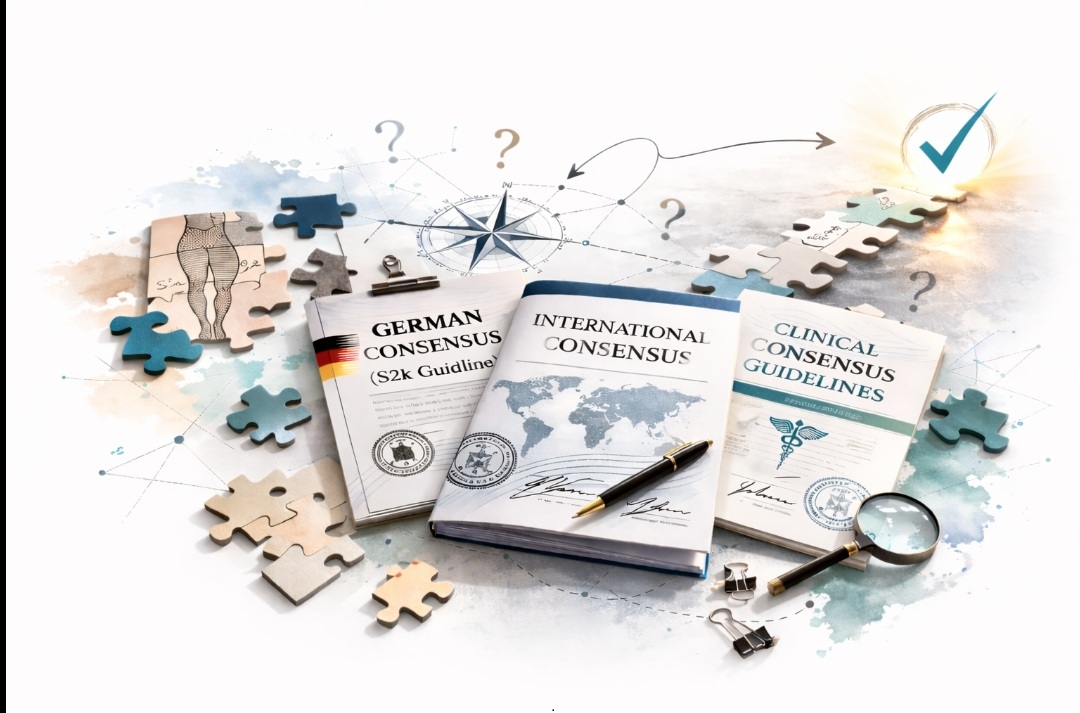
In parallel, Germany was developing its own formal guidance through the S2k guideline process. The German S2k guideline acknowledged lipoedema as a chronic condition, retained clinical diagnosis as central and explicitly recognised the role of conservative management alongside carefully selected surgical intervention. Importantly, it allowed space for complexity and heterogeneity rather than forcing a single explanatory mechanism. As a result, the German guideline has often been experienced by patients and clinicians as more pragmatic and more reflective of lived reality, even while acknowledging evidence limitations. The existence of two influential but philosophically different guideline positions has contributed significantly to international inconsistency in diagnosis, management and professional confidence.
Why the Name Matters in Diagnosis
At the same time, the 2020 European consensus attempted something even more destabilising: a move away from the term lipoedema itself. Because “oedema” implies fluid, the authors proposed renaming the condition lipalgia, shifting the emphasis purely to fat and pain. The renaming did not take hold. Pain alone does not describe the condition. It does not account for its patterning, progression, tissue change or functional impact. Although the term failed to gain traction, the damage was done. Once a condition cannot settle on a name, diagnosis becomes fragile.
More recently, some groups have adopted the term ‘lipedema syndrome’ in an attempt to acknowledge complexity without committing to a single mechanism. While well-intentioned, this has added another layer of confusion for women encountering different terminology in different clinics, publications and professional groups.
Power, Authority and Tone in Lipoedema Medicine
What followed the 2020 consensus was not healthy disagreement but polarisation. A dominant corrective voice emerged, increasingly confident and narrowing in scope. Clinicians and women with lipoedema who did not fit neatly within that framework often felt marginalised. Language became moralised. Authority became performative. Instead of openly discussing uncertainty, the field began policing it. For many women, this is where trust began to erode.
In response to that fracture, the Lipedema World Alliance was formed. Its intention was not to replace one authority with another, but to widen the conversation again. A new position paper was agreed through an International Delphi process and published in 2026. It mapped areas of agreement and disagreement and explicitly acknowledged unresolved questions rather than closing them down. This helped rebalance the discussion, but it did not erase the divide. The field remains tense, particularly where evidence, surgery and physiological mechanisms are contested.
NICE, Evidence and the LipLeg Trial
In the UK, these international disagreements intersect directly with the work of the National Institute for Health and Care Excellence (NICE). In March 2022, NICE concluded that there was insufficient evidence to support routine surgical management of lipoedema, and that liposuction in the UK should only be undertaken in a research context. That decision was procedural, based on the evidence available at the time, rather than a judgement of patient experience or the legitimacy of the condition itself. The expectation was that stronger evidence would eventually prompt review.
The German LipLeg trial was therefore always going to be pivotal, particularly given its alignment with the German S2k framework. Instead of opening a cautious reassessment, it became another flashpoint. Methodological critiques and concerns about conflicts of interest emerged rapidly, often delivered in a tone that many clinicians and patients experienced as dismissive. Once again, the message many people heard was not simply that the evidence had limits, but that they were mistaken to think it changed anything. Tone matters. When evidence is repeatedly discussed through dominance rather than dialogue, trust breaks down.
Why Diagnosis Still Feels Inconsistent
All of this plays out in the consulting room. Some clinicians rely heavily on the 2020 European consensus, a position also reflected in NHS Wales, despite the fact that the clinical landscape has shifted considerably since its publication. Others are influenced by the German S2k guideline. Some follow NICE interpretations, while others draw on the more recent Delphi-based position paper. In the absence of a single, authoritative framework, practice is also shaped by personal experience or informal teaching. Terminology varies. Beliefs vary. Confidence varies. You are not encountering inconsistency because you are unclear or asking the wrong questions. You are encountering it because the field itself has not yet settled.
Understanding this does not make the process easier, but it can make it less personal. This is not about winning arguments or choosing sides. It is about explaining why the system feels so difficult to navigate and why your experience of that difficulty is real.
The Lipoedema Lounge
If you would like to share your experience, whether as someone living with lipoedema, a clinician or a researcher, this is exactly what Lipoedema Lounge exists for. It is a space for complexity, uncertainty and lived reality, without reduction or dismissal. You are welcome to contact me and make an appintment to tell your story, in your own words in an interview to share with the community.