


Why diagnosis has become more complicated than ever
Awareness of lipoedema has transformed over the past decade. More women are recognising symptoms, asking questions and seeking help, which should be welcomed. Yet awareness has also changed the way many patients enter the healthcare system. Instead of attending a lipoedema assessment to establish a diagnosis, many come for confirmation of a diagnosis and treatment plan they have already implemented.
By the time they arrive at their first appointment, they have often spent months or years researching the condition. They have uploaded photographs of their legs to online groups and compared themselves with thousands of other women. Many have collected scientific papers they may not fully understand and accepted the opinions of complete strangers as fact. Most have already invested considerable sums on equipment, diets and exercise regimes before anyone has established whether they have lipoedema at all.
The rise of the armchair diagnostician
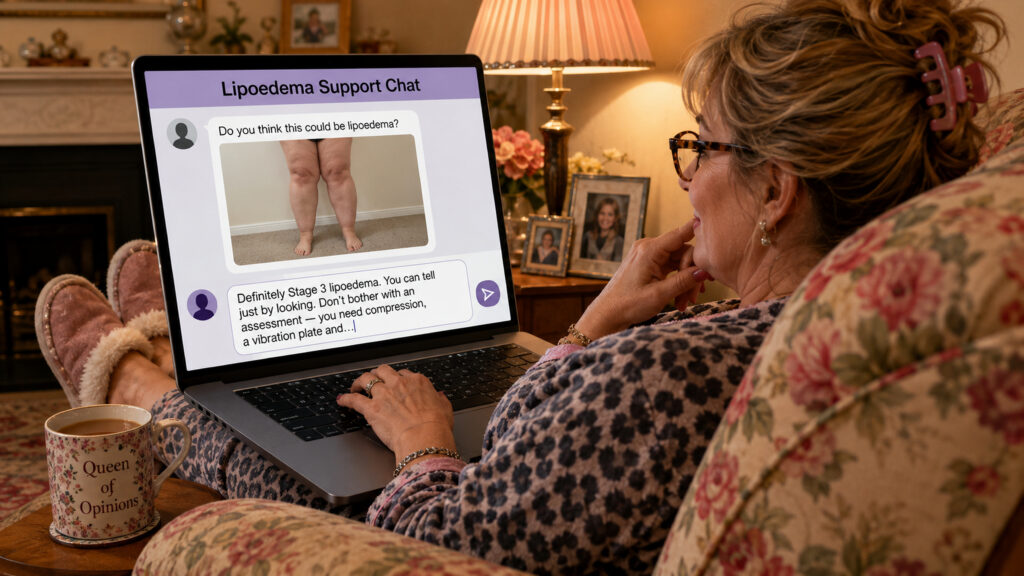
The internet has created a new phenomenon: the anonymous armchair diagnostician, hiding behind a quirky pseudonym. Uploaded photographs are analysed, diagnoses confidently given and treatment plans recommended by people who have never examined the troubled woman sitting behind the image. The reassurance is often immediate, but the certainty is not necessarily accurate.
Perhaps the most concerning aspect is that the most vehement opinions frequently come from people with absolutely no recognised healthcare qualifications whatsoever. Badges such as Top Contributor or Rising Contributor can give an impression of authority, but they simply reflect activity within an online community. The loudest voices are rarely challenged because they sound confident. Confidence, however, does not equate to competence. It is not evidence of clinical knowledge, specialist training or professional accountability.
The consultation often changes the story
A comprehensive assessment rarely focuses on a single diagnosis.
It asks why symptoms developed, how they have changed over time and what other conditions may be contributing. Sometimes the assessment confirms lipoedema. Sometimes it identifies obesity-related lymphatic dysfunction, chronic venous disease, hypermobility or another condition that requires a different treatment strategy. Often, several conditions coexist.
That is precisely why an individual assessment is important.
The goal is not to confirm what someone hopes to hear. It is to establish the most accurate explanation for their symptoms and develop a management plan that is safe, evidence-based and tailored to them.
Diagnosis is far more complex than pattern matching a photograph
If diagnosing lipoedema were as simple as recognising a pattern of fat distribution, there would be no need for specialist assessments.
The reality is very different.
Because there is currently no conclusive blood test, diagnostic scan, biopsy or laboratory marker for lipoedema, diagnosis requires careful history taking, clinical examination and the ability to distinguish lipoedema from the many other conditions that can produce similar symptoms. Family history, hormonal changes, weight history, pregnancy, miscarriage, endometriosis, fertility treatment, medication, connective tissue disorders, venous disease, the role of obesity and lymphatic dysfunction may all contribute to the overall picture.
Even among international experts, diagnosis continues to evolve.
The European Consensus Document (2020), the German S2k Guideline and the International Delphi Consensus (2025) all represent significant advances in our understanding of lipoedema, yet they do not agree on every aspect of the condition. Diagnostic criteria continue to evolve, classification remains debated and even the name itself is contested, with some experts still preferring the term lipalgia, using pain as a fixed diagnostic criterion.
If the world’s leading experts continue to refine and debate the evidence, it should give us pause before accepting a diagnosis made from a photograph uploaded to the internet.
When treatment comes before assessment
One of the greatest changes in recent years is not simply that people arrive believing they have lipoedema, but that many have already begun treating themselves.
Some have purchased ‘compression’ garments that are not medical grade without being measured. Others have invested in vibration plates, massage guns or gua sha tools after watching influencer recommendations online. Many have spent substantial amounts on supplements, specific types of myofascial or lymphatic therapies or online courses run by unqualified influencers whose only meaningful qualification is having 20,000 followers.
Increasingly, people are being encouraged to buy peptides from unregulated sources, microdose GLP-1 medications such as Mounjaro or Wegovy, or purchase syringes online with no medical supervision at all. These are prescription medications that have been tested under specific conditions, at specific doses and with appropriate clinical oversight, not as informal experiments shared between strangers online.
Others have embarked on intensive strength-training programmes because they have been told to “build muscle”, despite living with connective tissue disorders that require a very different approach to exercise.
None of these recommendations take account of the woman’s wider health. They ignore the medications they already take, co-existing conditions, previous surgery, cardiovascular risk, lymphatic function and countless other factors that determine whether a treatment is appropriate or potentially harmful.
Healthcare is individual. Advice given to thousands of anonymous people can never replace that.
Clinical expertise can be challenged
One of the more striking developments in modern healthcare can happen after the consultation.
Patients frequently return to the same online communities that helped shape their expectations and ask whether the clinician’s conclusions are correct.
Within minutes, strangers who have never examined them, never taken a medical history and never considered the full clinical picture confidently disagree with the assessment.
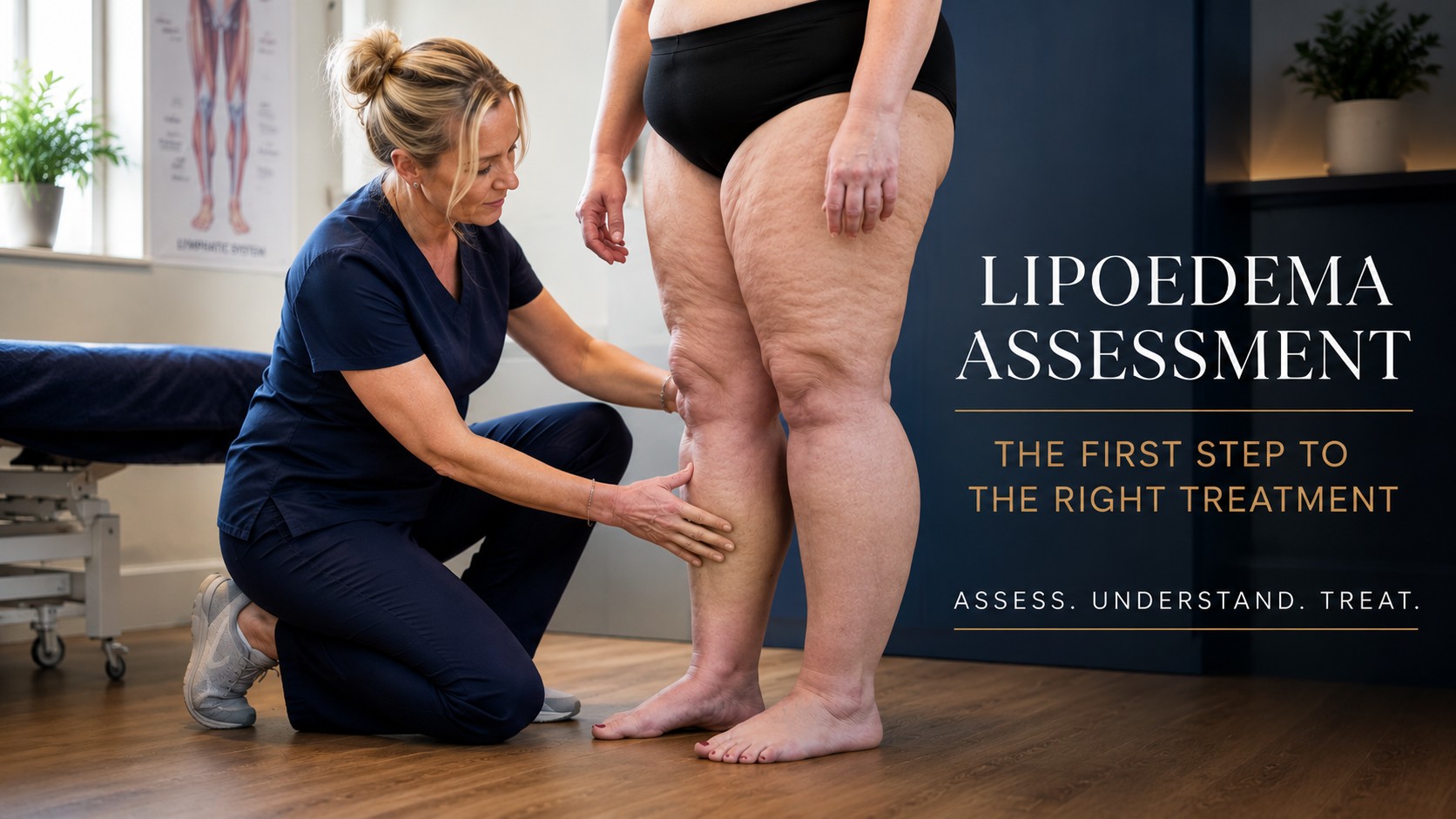
The clinician who has spent ninety minutes listening, examining, measuring and applying current evidence is dismissed by people who have seen nothing more than a photograph and a brief summary. That is not shared decision-making, it is replacing clinical assessment with collective opinion…and it can be dangerous.
Assessment is where real treatment begins
Assessment is not a hurdle to overcome before treatment starts, it is the process that determines whether treatment is needed, which treatment is appropriate and, just as importantly, which treatments should be avoided.
No online group can assess the whole person. Influencers cannot understand every diagnosis, medication, co-morbidity or risk factor from a photograph. No algorithm can replace clinical reasoning.
The best treatment plan is not the one that receives the most likes or comments. It is the one built on a thorough assessment, an accurate diagnosis and the best available evidence.
Because before anyone starts treating lipoedema, they first need to know that lipoedema is actually what they have.